Choose language

Automatically Submit CbC and GIR Reports to the Dutch Tax Administration

Multinational groups with consolidated revenue above the €750 million threshold face four international reporting obligations: CbC, Public CbCR, GIR and the Dutch top-up tax return. Two of these, CbC and GIR, must be submitted to the Dutch Tax Administration via Digipoort, and this is where the challenge lies: there is no public entry point.

SureSync Reporting validates your XML, submits it through a secure Digipoort connection and records every step. For Public CbCR (Chamber of Commerce) and the Dutch top-up tax return (IIR + QDMTT), we help you maintain data quality and consistency across filings, so you can work from a single source of data.

Stiven

Why choose SureSync Reporting for CbC and GIR?

From validated XML to confirmed submission to the Dutch Tax Administration

Our software takes care of the entire process, from your XML file through to confirmation by the Dutch Tax Administration. You upload the file to the SureSync portal, where we validate it against the applicable CbC or GIR schema. The submission is then made through a secure Digipoort connection. Responses and confirmations are automatically returned to the portal, so you always know when a filing has been accepted. No manual work, separate Digipoort scripts or intermediaries are required.

No entry point? No problem.

CbC and GIR do not have a publicly available Digipoort entry point. We provide the secure connection, including when you submit filings on behalf of multiple clients or entities. One technical route for both filings.

Compliant and fully auditable

Full alignment with the CbC and GIR schemas, automatic validation before submission and a complete audit trail for every filing. ISO 27001 certified, MFA access and a secure Digipoort connection. Questions from the Dutch Tax Administration? You can trace every change and action.

The Netherlands' leading XBRL and SBR expert

SureSync is the only Dutch organisation certified by XBRL. The same expertise behind our Chamber of Commerce and DORA solutions is applied to our CbC and GIR submission process: schema-level validation, automatic processing of taxonomy changes and direct connections to all relevant government channels. Read more here.

Your CbC data now does much more than ensure compliance

Since the introduction of Pillar Two, the quality of your CbC data is directly linked to your tax position. The transitional safe harbour allows groups to significantly simplify their GIR and QDMTT calculations through financial years ending in 2026, provided they pass the applicable tests based on CbC data. Poor-quality CbC data can mean missing out on the safe harbour, potentially resulting in an unnecessary top-up tax liability.
 
This makes CbC reporting much more than a compliance exercise. Organisations that have their data and processes under control already have 60 to 70% of the foundation for Pillar Two in place. SureSync Reporting is designed to make that same foundation work for GIR: the same source data, the same validation layer and the same audit trail.

How the four filings fit together

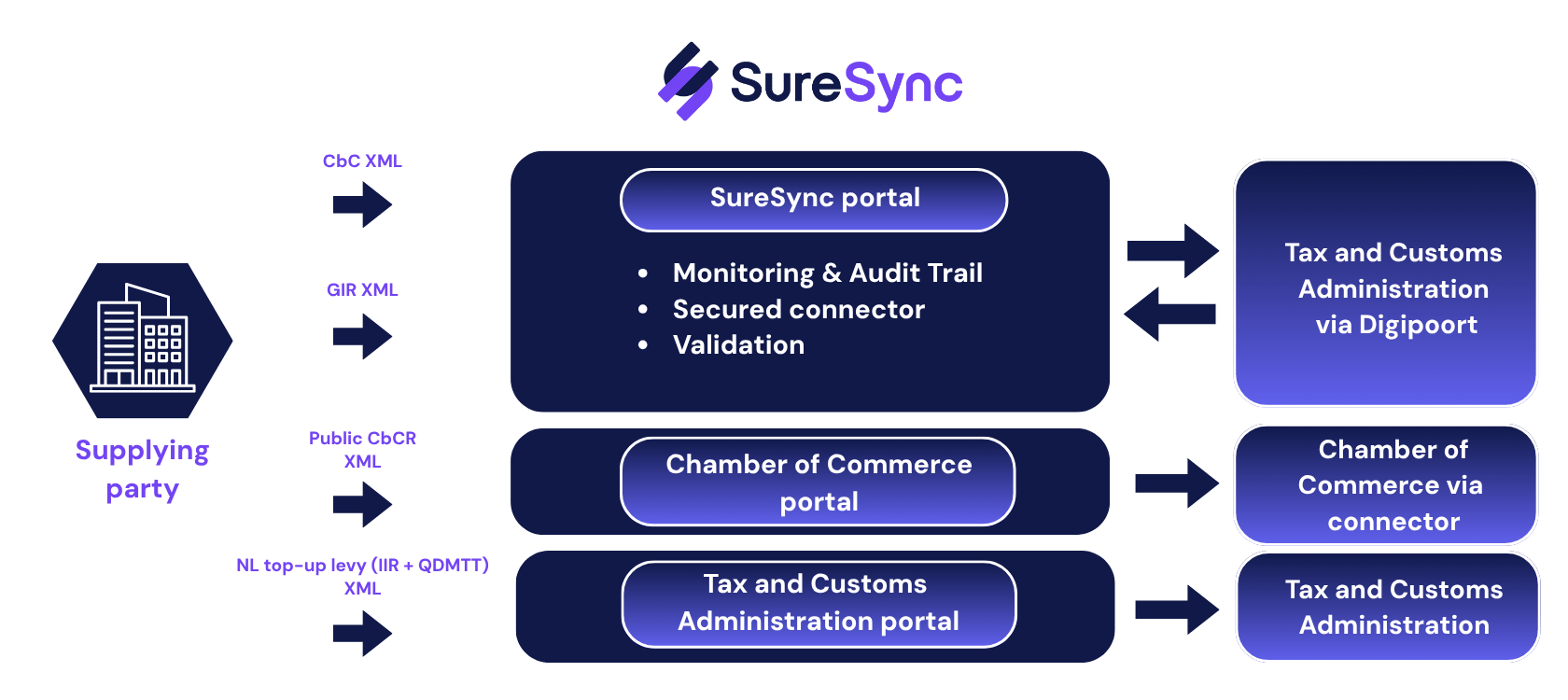
CbC & GIR Flow ENG

Multinational groups face four international tax reporting obligations. SureSync automates the submission of CbC and GIR to the Dutch Tax Administration via Digipoort. You submit Public CbCR and the Dutch top-up tax return (IIR + QDMTT) yourself through the Chamber of Commerce portal and the Dutch Tax Administration portal respectively. This overview shows how the four reporting flows are connected.

Schedule a consultation right away

In a brief conversation, we’ll explore together how you can automate your Country-by-Country reporting with the Tax Authority. Are you getting started for a single group or for a portfolio of clients? We’ll show you how SureSync works, discuss your current process, and answer questions about integration, liability, and pricing.

Agenda wordt geladen…

FAQ

As an SBR and XBRL specialist, we regularly receive questions about CbC and Pillar Two. Below are some of the questions we hear most often. Can't find your question? Get in touch with us.

Schedule a consultation right away

SureSync automates the submission of CbC (Country-by-Country) and GIR (GloBE Information Return) to the Dutch Tax Administration via Digipoort. These two filings do not have a publicly available Digipoort entry point and are technically the most complex to submit.

You submit the Public CbCR yourself through the Chamber of Commerce portal and publish it on your company's own website, where it must remain available in machine-readable format for five years. You also submit the Dutch top-up tax return (IIR + QDMTT) yourself through the Dutch Tax Administration portal.

The four filings overlap in their underlying source data. Keeping your CbC data accurate and up to date through SureSync puts you in a stronger position for the other three filings: the same figures, the same audit trail and fewer inconsistencies between reports.

The requirements apply to multinational groups with consolidated annual revenue of at least €750 million. Deadlines vary by filing:

  • CbC: notification by the final day of the financial year; the report must be submitted within 12 months after the end of the financial year.
  • Public CbCR: filing with the Chamber of Commerce within 12 months after the end of the financial year, plus publication on the company's own website. This applies to financial years starting on or after 22 June 2024.
  • GIR: notification by 30 June 2026 for FY2024. The first filing is due 18 months after the end of the financial year, followed by a 15-month deadline in subsequent years. For FY2024, this means 30 June 2026. The Digipoort portal opens from 1 June 2026.
  • Dutch top-up tax return (IIR + QDMTT): due 17 months after the end of the financial year, with a 20-month deadline for the first year. For FY2024, this means 31 August 2026. The return only needs to be filed where top-up tax is actually due.

The GIR must also be filed when there is no net top-up tax liability. This is something that is regularly overlooked.

CbC is the confidential report submitted to the Dutch Tax Administration under OECD BEPS Action 13. Public CbCR is a shortened public version that is filed with the Chamber of Commerce and published on your own website, based on EU Directive 2021/2101.

The GIR (GloBE Information Return) is the global information return under Pillar Two. The Dutch top-up tax return covers the IIR (top-up tax on foreign low-taxed entities) and the QDMTT (domestic top-up tax on Dutch entities).

The four reporting flows overlap in their underlying data, but differ in format, submission channel and deadline.

Read more about the three reporting flows: “Submitting CbC via Digipoort: Why There Is No Standard Entry Point

Under Pillar Two, groups can apply a simplified calculation through FY2026 if they pass three tests based on their CbC data: the de minimis test, simplified ETR test and routine profits test.

If a group qualifies for the safe harbour, it does not have to perform the full GloBE calculation for that jurisdiction. The downside is that inaccurate or incomplete CbC data can cause you to miss the safe harbour, resulting in the full calculation and potentially additional top-up tax.

In short, the quality of your CbC data now has a direct tax impact.

The Dutch Tax Administration receives CbC and GIR reports through Digipoort, but there is no publicly available entry point like there is for SBR financial statements.

In practice, this means that submitting parties need to establish their own technical connection or work with a service provider that already has a Digipoort integration. SureSync provides that connection.

Want to know more? You can read more about this in our blog post on the three reporting streams.

Yes. Firms that submit tax filings on behalf of their clients can set up, validate and submit filings for each client through the SureSync portal. Access rights and permissions are managed per user and per client.

Pricing depends on the number of groups, filings and jurisdictions you submit for. Contact us for a tailored indication.

Learn more about CbCR