

SureSync Taxonomy develops, publishes and manages XBRL taxonomies for reporting chains and sectors. A taxonomy defines which data exists, what it is called and which rules apply. That way everyone who submits data speaks the same language, and errors are caught before they enter the chain.

What SureSync Taxonomy does
From definition to publication, fully covered
One dictionary for the whole chain
Terms, definitions and reporting guidelines live in one central taxonomy. Everyone in the chain uses the same meaning.
Management fully taken care of
SureSync handles the entire process: functional analysis, development, publication, validation and maintenance.
Fits how data is submitted
The taxonomy works with automated system-to-system exchange and, where needed, with an entry portal for organizations without a connection.
Based on the international XBRL standard
Data is consistent internally and comparable externally, and matches what regulators expect.
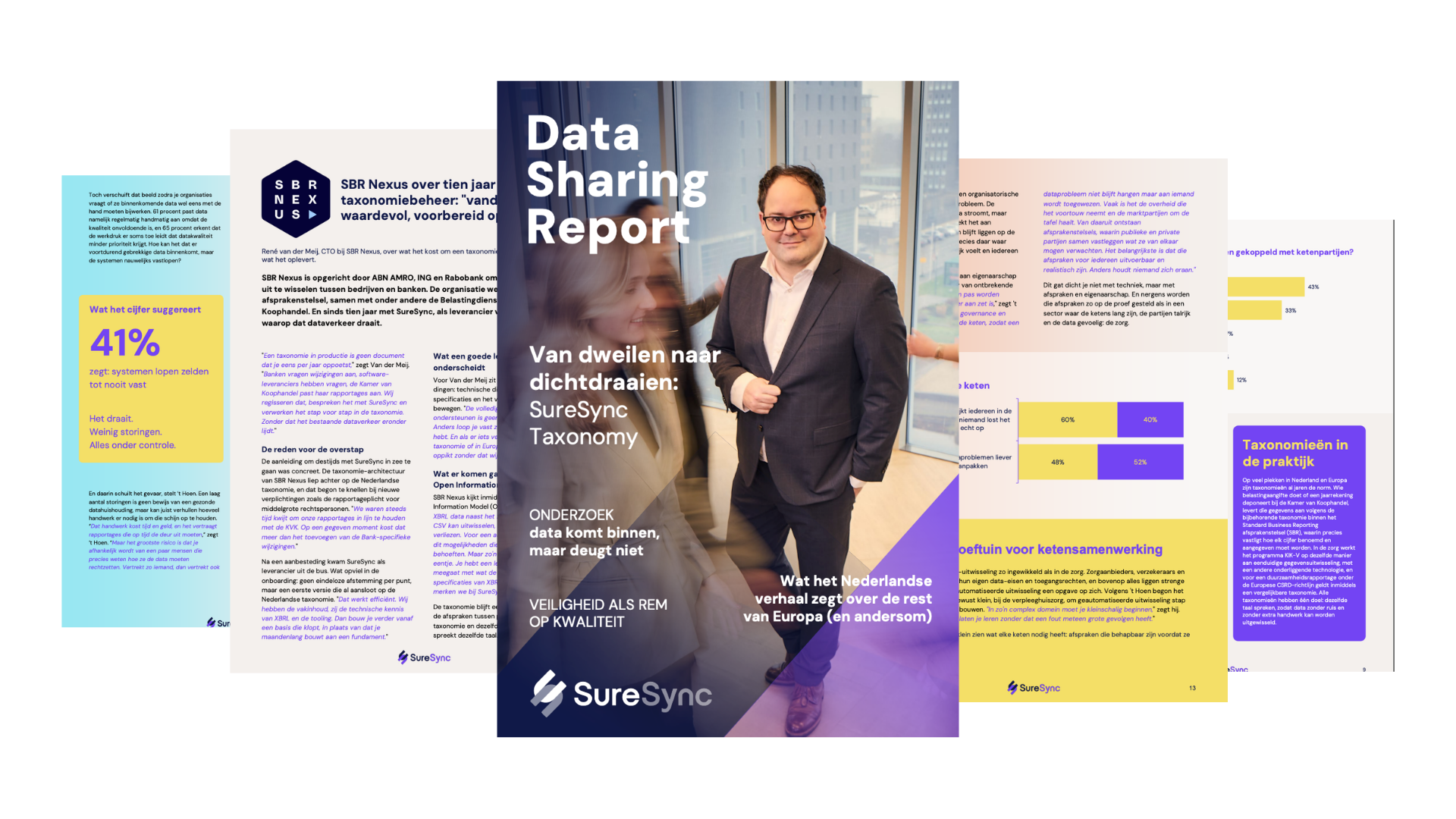
Data Sharing Report
Connected, but not speaking the same language
At 81 percent of organizations, systems are connected to those of chain partners. Yet 82 percent regularly receive incomplete or incorrect data, and 61 percent correct it by hand. That is what the SureSync Data Sharing Report shows, a survey among 433 decision-makers.
A connection between systems does not guarantee a shared meaning. "A taxonomy is essentially a dictionary. It defines which data elements exist, which labels belong to them and which validation rules apply," says Sander 't Hoen, Lead Taxonomy Development & Tooling at SureSync and chair of XBRL Netherlands.

Customer story
Ten years of collaboration with SBR Nexus
René van der Meij, CTO of SBR Nexus, looks back on ten years of working with SureSync and looks ahead to developments such as the Open Information Model.
"SureSync helps us keep our taxonomies up to date, which enables banks to receive reliable, high-quality data."
Organizations that already rely on SureSync




Frequently asked questions about SureSync Taxonomy
Can't find your question? Ask one of the SureSync experts, such as Sander 't Hoen.
A taxonomy is a standardized dictionary. It defines which data elements exist, which labels belong to them and which validation rules apply. That way all organizations in a chain record data in the same way, and information is unambiguous and comparable.
For organizations that have a taxonomy developed and managed for their chain or sector, such as chain coordinators and regulators. Do you submit data yourself, for example annual accounts to the Dutch Chamber of Commerce (KVK)? Then take a look at SureSync Validate and SureSync Reporting.
For financial reports, sustainability reports (such as CO₂ emissions and ESG indicators) and statutory filings, for example with the Chamber of Commerce or regulators.
SureSync develops and publishes taxonomies according to the international XBRL standard and keeps them up to date when legislation changes. SureSync Validate, the validation software of SureSync, was fully XBRL-certified again in 2026.
SureSync takes care of the entire process: analysis, taxonomy development, publication and maintenance. Where needed, an entry portal is added for organizations that don't submit data through a connection.