
Choose language

Data exchange in the supply chain

The data gap in the supply chain

Organizations are technically connected, but they don't always speak the same data language. 82% receive incomplete or incorrect data, and 61% correct it manually. Where does it go wrong?

Data Sharing Report Taxonomies Data Sharing Report Taxonomies

Research

"As long as it's done by hand, mistakes will creep in"

41% report that their systems rarely go down. Yet 61% still correct incoming data by hand. Sander 't Hoen explains why.

Sander 't Hoen SureSync Sander 't Hoen SureSync

Key findings from the study

For this report, we spoke with 433 decision-makers and influencers across IT, Finance, Data, Compliance, and Legal, all working at organizations with 250 or more employees. Three trends stood out.

Data Sharing Report Taxonomy

The data is flowing in, but it isn't fit for use

At 81% of organizations, internal systems are linked to those of supply chain partners. Technically, the connection works. In terms of content, it often doesn't: 82% regularly receive data with amounts in the wrong currency format, empty fields, or the same product listed under two different names. A connection between two systems doesn't guarantee a shared understanding. Without a shared language, every exchange is a translation — and something always gets lost in it.

Data Sharing Report: Manual Work

Hidden manual work moves the problem out of sight

On paper, everything works. But 61% manually adjust incoming data, and 65% admit that workload sometimes takes precedence over data quality. Systems don't appear to fail — precisely because employees catch the errors before they enter the system. That manual work doesn't solve the problem; it simply moves it somewhere reports don't reach, and where the knowledge walks out the door the moment the employee does.

Data Sharing Report Governance

Governance is still the sticking point: who owns the problem?

60% recognize the pattern: when a data issue surfaces, everyone in the chain looks at everyone else, and no one actually fixes it. 48% go further, saying partners would rather cover up mistakes than address them. This isn't a technical problem; it's a governance problem. Nowhere is it defined who is responsible when things go wrong, so the issue gets stuck at the boundary between organizations.

Background

SBR Nexus on a decade of taxonomy management: "Valuable today, prepared for tomorrow"

CTO René van der Meij (SBR Nexus) on ten years of taxonomy management with SureSync, from the original architecture to the migration to the Open Information Model.

SBR Nexus and SureSync SBR Nexus and SureSync

Get the Data Sharing Report

This edition of the Data Sharing Report includes the full survey of 433 decision-makers, expert analysis by Sander 't Hoen, an interview with René van der Meij of SBR Nexus, and an international perspective on where the Netherlands is leading the way in taxonomy management and where the broader market is still lagging behind.

Other editions of the Data Sharing Report:

Data Sharing Report: AI and Healthcare

AI in Healthcare: More Than Just a Technological Issue
From administrative processing to diagnostics: AI now touches virtually every aspect of the healthcare process. But while adoption is proceeding at breakneck speed, policy, knowledge management, and data quality are lagging behind.
DSR-2-visual-pages

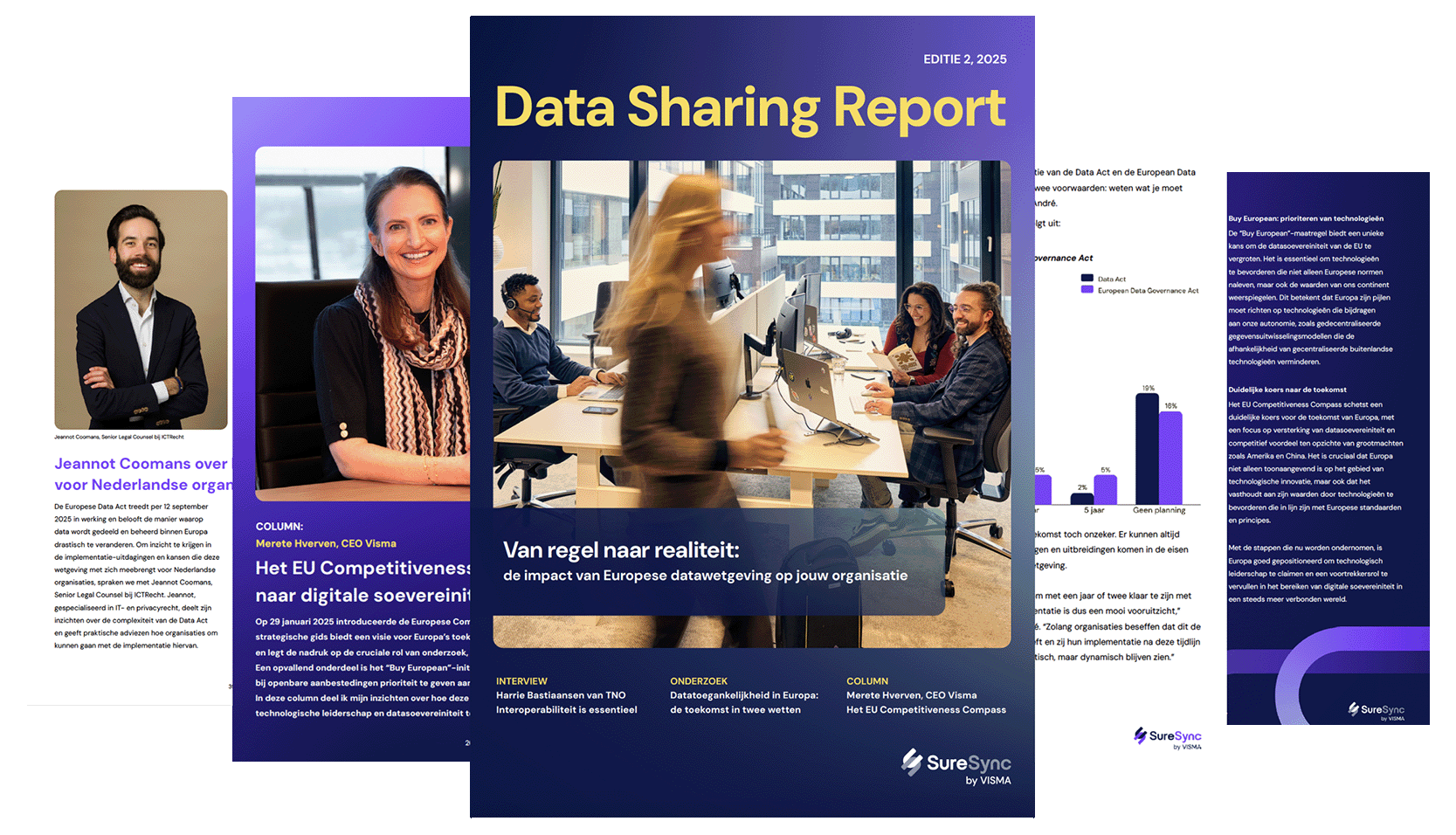
From Regulation to Reality: The Impact of European Data Legislation

The way organizations exchange, store, and secure data is changing rapidly. New European legislation, such as the Data Act and the European Data Governance Act, presents companies with new challenges and opportunities.